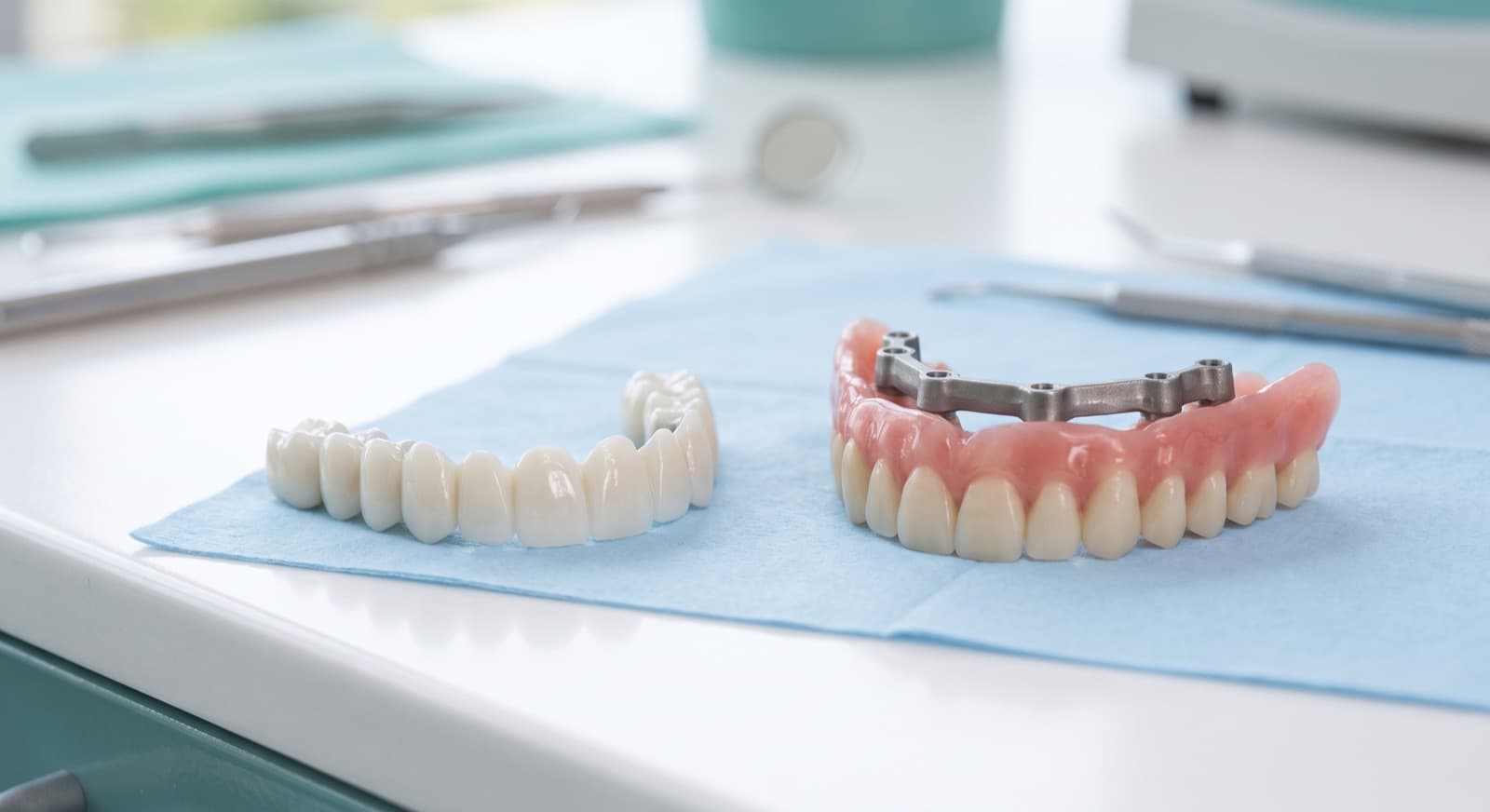
When people research full-arch implant treatment, most of the attention goes to the surgical side — how many implants, whether same-day teeth are possible, how long healing takes. Yet one of the decisions that most shapes everyday life with your new teeth is what the final bridge is actually made of. At Shine Dental Newington, Dr. Jin-Ho Cho — a University of Sydney graduate (BDS, 1987) with 35+ years in practice and 9,000+ dental implant fixtures placed — discusses two main material pathways with every All-on-X patient: acrylic or composite teeth on a titanium framework, or monolithic zirconia. This guide explains how they differ and how the choice is made. If you are new to the treatment itself, start with our overview of what All-on-X dental implants are.
What materials are used for the final All-on-X prosthesis?
All-on-X treatment usually involves two bridges over its course. The provisional bridge — fitted early in treatment, on the same day as surgery where clinically suitable — is typically made from acrylic and is designed as a temporary working set of teeth while the implants integrate with the bone. The final prosthesis is made only after osseointegration is confirmed, which takes months, and this is where the material decision matters most.
The two main options for the final bridge are: acrylic or composite teeth bonded to a precision-milled titanium framework (often called a hybrid bridge), and monolithic zirconia, where the entire bridge is milled from a single block of high-strength ceramic. Both are established options supported on typically four to six implants per arch. They differ meaningfully in strength, weight, wear behaviour, repairability and aesthetics — which is why the choice deserves a proper conversation rather than a default.
How does an acrylic-titanium hybrid bridge perform day to day?
A hybrid bridge pairs a rigid titanium bar — which gives the structure its strength and precise fit on the implants — with acrylic or composite teeth and gum-coloured material layered over it. In daily use, many patients find this combination has a slightly softer, quieter feel when the teeth come together, because acrylic absorbs a little more of the contact than ceramic does.
The trade-off is wear. Acrylic and composite teeth gradually wear down with years of chewing, and they can pick up surface staining from coffee, tea and red wine over time. The upside is serviceability: individual teeth on a hybrid bridge can often be repaired or replaced by the laboratory without remaking the entire prosthesis, because the titanium framework underneath remains intact. For some patients, that repair pathway is a genuine practical advantage.
What makes monolithic zirconia different?
Monolithic zirconia is milled from a single solid block of zirconium-oxide ceramic, then characterised and glazed so the teeth and gum portions look natural. Because there are no joins between framework and teeth, there is no interface where teeth can debond.
Zirconia is notably strong and highly resistant to wear and staining — the tooth shape and surface polish it has at fitting is largely the surface it keeps. It is also heavier and more rigid than a hybrid bridge, which some patients notice initially and most stop noticing quickly. The repair picture is different, too: chips and fractures are uncommon, but when damage does occur, repairs generally involve laboratory work on the bridge itself rather than a simple tooth swap. Aesthetically, modern multi-layered zirconia can be highly lifelike, with colour that stays stable over the years.
How do the two options compare on strength, weight, wear, repairs and aesthetics?
A practical side-by-side summary:
- Strength: zirconia offers greater resistance to fracture of the tooth surfaces; hybrid bridges rely on the titanium bar for structural strength while the acrylic teeth remain the softer element.
- Weight: hybrid bridges are lighter; zirconia is denser and feels more solid.
- Wear: acrylic and composite teeth wear and can stain over years; zirconia is highly wear- and stain-resistant.
- Repairability: hybrid teeth are usually simpler to repair or replace individually; zirconia rarely needs repair but is more involved to fix when it does.
- Aesthetics: both can look natural; zirconia tends to hold its appearance longer, while hybrids may need refreshing over time.
Neither material is universally superior — the right choice depends on your bite, habits and priorities. Patients who grind heavily, for example, raise different considerations than patients whose priority is easy serviceability.
How does the material choice affect your All-on-X quote?
The two pathways involve different laboratory processes, milling work and materials, so they are itemised differently. At Shine Dental Newington you receive a written, itemised quote with individual item numbers before treatment begins, so you can see exactly what each component covers and compare options on a like-for-like basis. We do not publish figures because every case differs — our All-on-X cost guide for Sydney explains what drives the numbers and how to read a quote properly.
On the payments side, HICAPS is available for on-the-spot private health claims, and the practice is a preferred provider for CBHS and NIB. Medicare typically does not cover routine adult dental treatment. If you are comparing practices, our guide to questions to ask an implant dentist includes the material questions worth raising.
How does Dr. Cho approach material selection at your consultation?
Material selection at Shine Dental Newington is part of the planning conversation, not an afterthought. Dr. Cho — who serves as a KOL (key opinion leader) for the DIO Implant System — considers your bite force and opposing teeth, any history of grinding or clenching, the condition of your jaw as shown on the CBCT scan, your aesthetic priorities, and how you weigh long-term wear against repairability. He then explains how each option would play out for your specific case, in plain terms, before you decide together.
Consultations are available in English and Korean, and the CBCT scan is taken on site as part of the same visit, so the discussion is grounded in your actual anatomy rather than generalities.
Ready to discuss your All-on-X material options?
If you are weighing up a hybrid bridge against monolithic zirconia — or you are still earlier in your research — a consultation is the place to get case-specific answers. Call Shine Dental Newington on (02) 9748 4822 or book online. You will find us at Unit 5, 8 Avenue of Americas, Newington NSW 2127, with onsite parking, and consultations available in English and Korean.