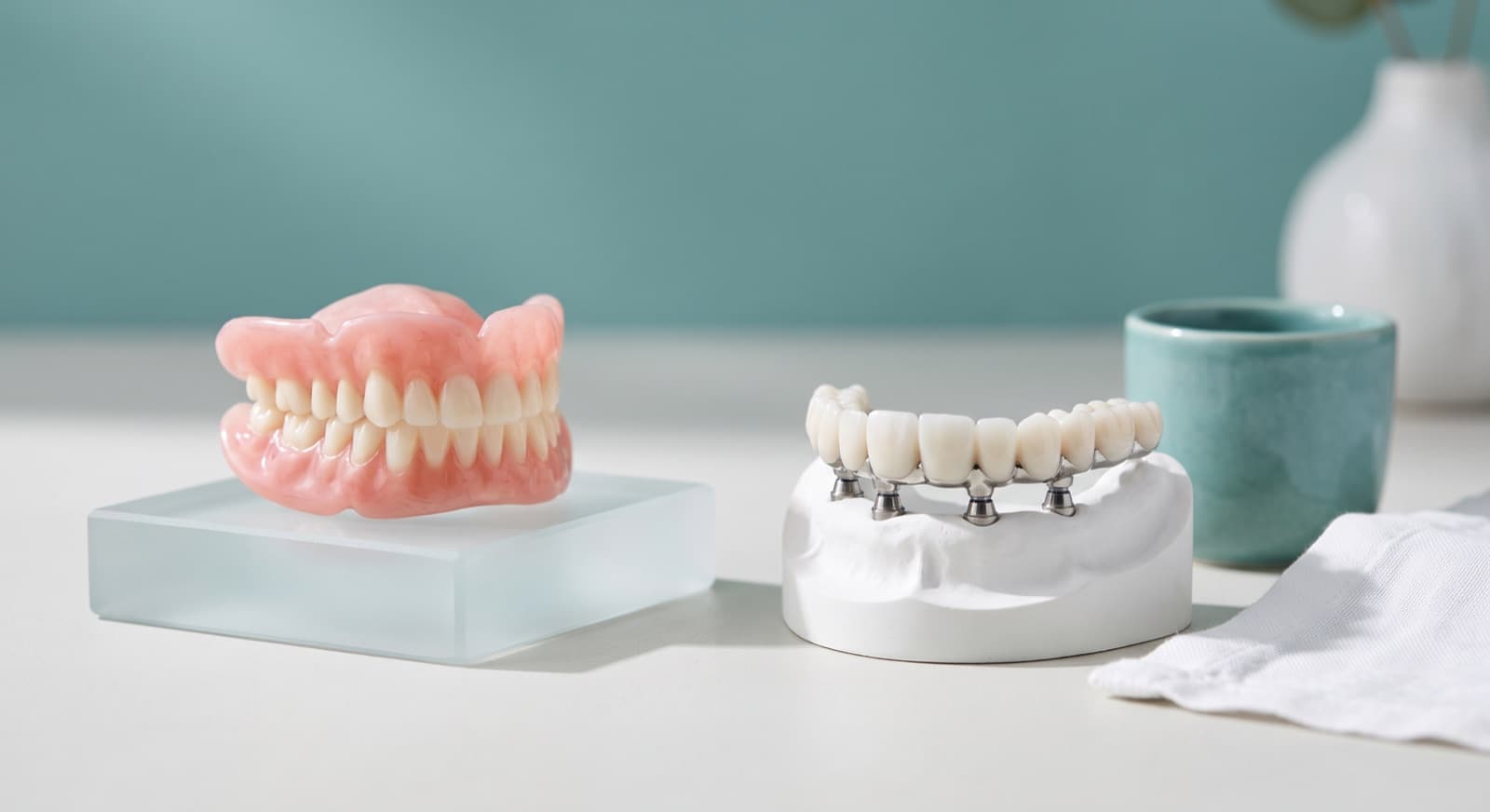
When a full arch of teeth can no longer be saved, most people in Sydney face the same two realistic options: a removable full denture, or a fixed bridge supported by dental implants — the treatment known as All-on-X. Both replace a complete arch of teeth, but they do so in fundamentally different ways, and each suits different people, mouths, and circumstances. This article compares the two honestly across the things that matter day to day: stability, bone health, eating and speaking, maintenance, and how each option tends to age. Neither is universally right; the aim is to help you walk into a consultation knowing which questions to ask.
What Is the Actual Difference Between All-on-X and Full Dentures?
A full denture is a removable acrylic appliance that rests on the gums. The upper denture covers the palate and relies largely on suction; the lower rests on a horseshoe-shaped ridge of gum and is held mostly by gravity, muscle control, and practice. Dentures are made without surgery, which is a genuine advantage for patients who cannot or prefer not to have implants placed.
All-on-X takes the opposite approach: typically four to six dental implants are placed in the jaw per arch, and a fixed bridge of teeth is attached to them. The bridge does not come out at night and is removed only by your dentist for maintenance. The teeth are supported by the bone via the implants rather than resting on the gum. If you would like the treatment explained from the ground up, start with what All-on-X dental implants are.
Which Is More Stable for Eating and Speaking?
Stability is where the two options differ most in daily life. Because a denture rests on soft tissue, it can shift when you bite into firm food, and lower dentures in particular are prone to movement. Many denture wearers adapt well, but common compromises include cutting food smaller, avoiding harder or chewier foods, and using adhesive. The palate coverage of an upper denture can also mute the sense of taste and temperature for some wearers.
Because an All-on-X bridge is anchored to implants, it does not rely on suction or adhesive, and biting forces are transferred through the implants into the bone. Most patients find chewing capacity with a fixed bridge is closer to natural teeth than a removable denture allows, and speech is generally unaffected once the initial adaptation period passes, since there is no palate plate. That said, All-on-X is not identical to natural teeth: the bridge needs a short adjustment period, and sensible eating habits still matter — especially during healing, as we cover in recovery after All-on-X.
What Happens to Your Jawbone With Each Option?
This is the least visible difference, and arguably the most important over a span of years. Jawbone is maintained by the stimulation of chewing forces travelling through tooth roots. When all teeth are lost, that stimulation disappears and the bone ridge gradually resorbs — it slowly shrinks in height and width. A denture resting on the gum does not transmit meaningful stimulation to the bone, so resorption continues underneath it. This is why dentures loosen over time and periodically need relining or remaking, and why long-term denture wearers often notice changes in facial profile around the lips and chin.
Implants behave more like tooth roots in this respect. Because chewing forces pass through the implant fixtures into the jaw, the bone around them continues to receive functional stimulation, which helps preserve bone volume in those areas. This is one reason timing matters: the longer an arch has been without teeth, the more bone has typically been lost, which can affect how and where implants can be placed. A CBCT scan at consultation shows exactly what bone remains.
How Does Daily Care and Maintenance Compare?
Dentures are removed for cleaning, brushed separately from the mouth, and generally taken out overnight to rest the gum tissue. Ongoing maintenance includes periodic relines as the ridge changes shape, occasional repairs, and eventual remakes. There is no surgery, but there is a lifelong cycle of adjustment.
An All-on-X bridge is cleaned in the mouth. You brush it like natural teeth and clean underneath it daily using tools your dentist recommends, such as water flossers, interdental brushes, or floss threaders. Professional maintenance visits are essential: the bridge is periodically removed by the dentist so the implants and gum can be examined and cleaned thoroughly. Hygiene is not optional with implants — the gum and bone around implants can develop inflammation if plaque accumulates, so patients need to be willing to maintain the routine.
Who Tends to Suit Dentures — and Who Tends to Suit All-on-X?
Dentures remain a reasonable choice for patients who want to avoid surgery, who have medical circumstances that make implant treatment less suitable, or for whom the investment in implant treatment is not currently practical. Modern dentures, well made and well fitted, serve many people acceptably.
All-on-X tends to suit people with failing teeth who want a fixed, non-removable result; long-term denture wearers who have run out of patience with movement and adhesives; and patients who place a high value on chewing function and bone preservation. Suitability depends on health, bone volume, and habits such as smoking — we cover this fully in who is suitable for All-on-X.
On longevity: a well-maintained implant-supported bridge is designed as a long-term solution, though the prosthetic teeth are subject to wear like any restoration and components may need servicing over the years. Dentures typically need relining or replacing on a shorter cycle as the ridge changes. Costs for the two paths are structured very differently, which is why comparing them requires an itemised quote rather than guesswork — see what determines dental implant costs in Sydney for how implant quotes are built.
Book an All-on-X Consultation
The right full arch option is a personal decision made with proper clinical information: an examination, a CBCT scan, and a frank conversation about your goals, health, and budget. Dr. Jin-Ho Cho, BDS (University of Sydney, 1987), brings 35+ years of clinical experience and 9,000+ implant fixtures placed, and is a KOL for the DIO Implant System. Consultations are available in English and Korean, and every patient receives a written itemised quote with item numbers — with HICAPS on-the-spot claiming and preferred provider arrangements with CBHS and NIB. Call Shine Dental Newington on (02) 9748 4822 or book a consultation at Unit 5, 8 Avenue of Americas, Newington NSW 2127.