If you have lost one or more teeth, you have probably already searched whether dental implants could work for you — and found plenty of conflicting answers. The honest position is this: most adults with missing teeth are potential candidates for dental implants, but suitability is an individual clinical question, not a quiz you can pass online. This guide walks through the factors that genuinely matter — the state of your mouth, your bone, your gums and your general health — so you can understand your own situation better before an assessment. It is written to inform, not to diagnose; only an examination with 3D imaging can do that.
Which Missing-Teeth Situations Can Implants Address?
Implants are versatile, and the range of situations they can address is wider than many people expect. A single missing tooth — whether lost to decay, gum disease, a failed root canal or an accident — can be replaced with one implant supporting one crown, without cutting down the healthy teeth beside it. Several missing teeth in a row can often be restored with an implant-supported bridge, which usually needs fewer implants than the number of teeth being replaced.
At the fuller end of the spectrum, people missing all teeth in one or both jaws — including long-term denture wearers who are tired of movement, food restrictions or adhesives — may be candidates for full-arch treatment. An All-on-X approach supports an entire arch of fixed teeth on a small number of strategically placed implants. Each scenario has different planning demands, which is exactly why assessment comes before recommendation.
Do I Have Enough Bone for an Implant?
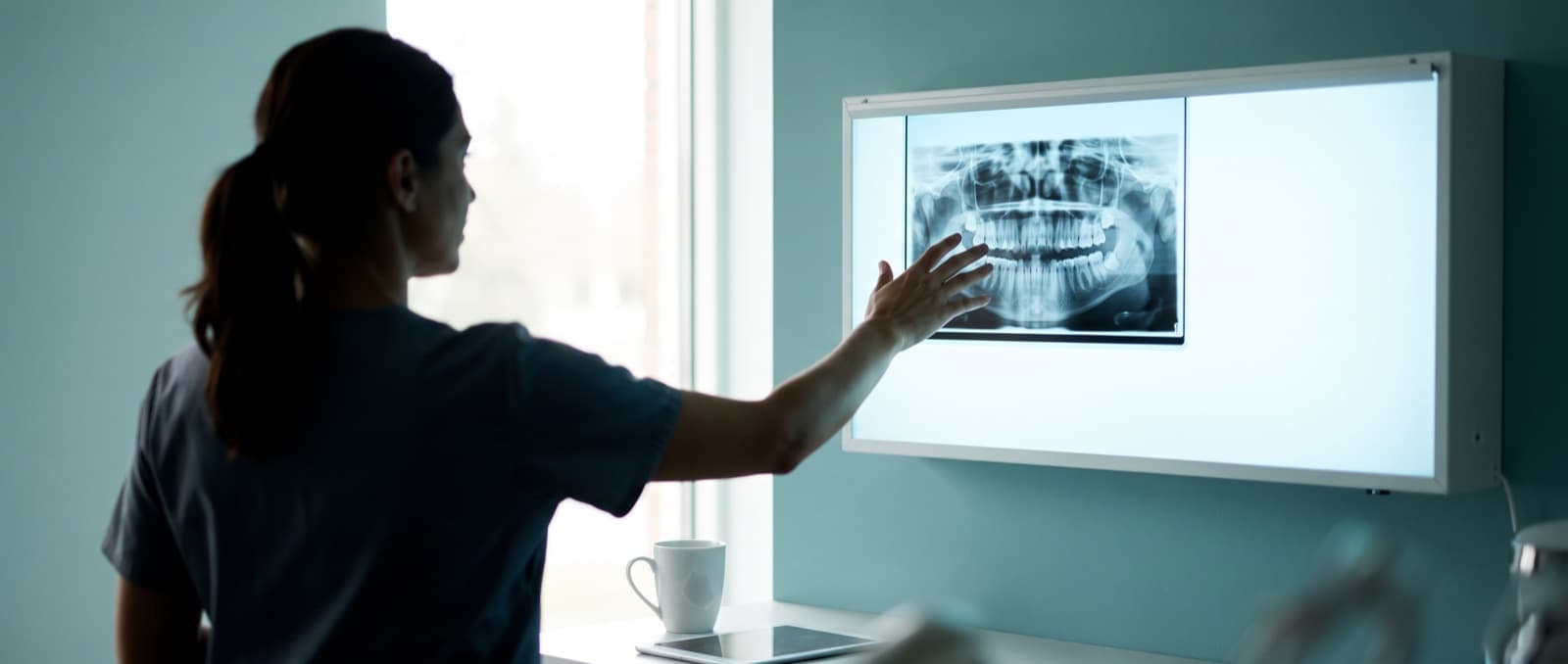
This is the question that most often cannot be answered without imaging. An implant fixture needs sufficient bone height and width to hold it securely, and bone naturally shrinks after a tooth is lost — a process that continues over years. Someone who lost a tooth last month usually has more bone available than someone who lost it a decade ago, and long-term denture wearers often have significant resorption.
The good news is that limited bone rarely closes the door. It changes the plan. Options can include bone grafting to rebuild volume, sinus lift procedures in the upper back jaw, or choosing implant positions and angles that make better use of the bone you still have — a principle that full-arch All-on-X planning relies on. What your jaw actually offers is measured precisely on a CBCT scan, not guessed from a mirror.
How Do Gum Health and Age Affect Suitability?
Healthy gums are non-negotiable. Active gum disease (periodontitis) is one of the main threats to implants, because the same bacteria that attack natural teeth can attack the tissues around an implant. If gum disease is present, it needs to be treated and stabilised first — that postpones implant treatment rather than preventing it.
Age works differently to how most people assume. There is no upper age limit for dental implants: seniors in reasonable health are routinely treated, and healing capacity matters far more than the number on your birth certificate. The genuine age restriction sits at the other end — implants are generally not placed in teenagers or young adults whose jaws are still growing, because an implant does not move with a growing jaw.
What About Smoking and Diabetes?
Neither smoking nor diabetes automatically rules you out, but both deserve a straight factual discussion. Smoking reduces blood flow in the gums and is associated with slower healing and higher complication rates around implants. Many smokers still proceed with treatment; dentists commonly recommend reducing or stopping smoking around the surgical and healing period, and it is a factor weighed openly in planning.
Diabetes matters mainly through its control. Well-managed diabetes is generally compatible with implant treatment, while poorly controlled blood sugar impairs healing and raises risk. If you are diabetic, expect your dentist to ask about your recent management and possibly to liaise with your GP. The same collaborative approach applies to other conditions and medications that affect bone or healing, including some osteoporosis medications, which require individual assessment rather than a blanket answer.
What Rules Implants Out — Temporarily vs Permanently?
Most obstacles to implant treatment are temporary. Active gum disease, an unhealed extraction site, uncontrolled diabetes, a mouth that needs other dental work stabilised first, or timing considerations such as pregnancy — each of these means "not yet", not "never". Once the underlying issue is managed, planning can resume.
Genuinely permanent exclusions are uncommon. Ongoing jaw growth in young patients is the clearest one, and it resolves itself with time. A small number of medical situations — certain intravenous bone medications or a history of radiotherapy to the jaw, for example — require careful case-by-case evaluation with your medical team. For the large majority of adults, the realistic question is not whether implants are possible, but which pathway and preparation your individual case needs.
Why a CBCT Consultation — Not a Checklist — Gives the Answer
Everything above describes tendencies, not verdicts. You cannot see your own bone volume, nerve position or sinus anatomy, which is why self-diagnosis — in either direction — is unreliable. Some people assume they are unsuitable and live with a gap unnecessarily; others assume a quick fix and are surprised that preparation is needed.
At Shine Dental Newington, suitability is determined properly: a digital examination, a 3D CBCT scan where indicated, and an honest conversation with Dr. Jin-Ho Cho, who has placed 9,000+ implant fixtures over 35+ years of clinical practice. You then receive a written, itemised quote with item numbers, so you know exactly what is proposed. If you want to understand what treatment itself involves, read our step-by-step guide to the implant procedure and our honest answer to whether dental implants hurt.
Find Out Where You Stand — Book an Assessment
The fastest way to replace uncertainty with facts is a consultation. Dr. Cho consults in English and Korean at Shine Dental Newington, Unit 5, 8 Avenue of Americas, Newington NSW 2127 — with onsite parking, and convenient to Sydney Olympic Park, Wentworth Point, Auburn, Lidcombe, Homebush, Silverwater, Ermington and Rydalmere. HICAPS claims are processed on the spot, and the practice is a preferred provider for CBHS and NIB. Call (02) 9748 4822 or request a consultation online to find out whether implants are right for you.