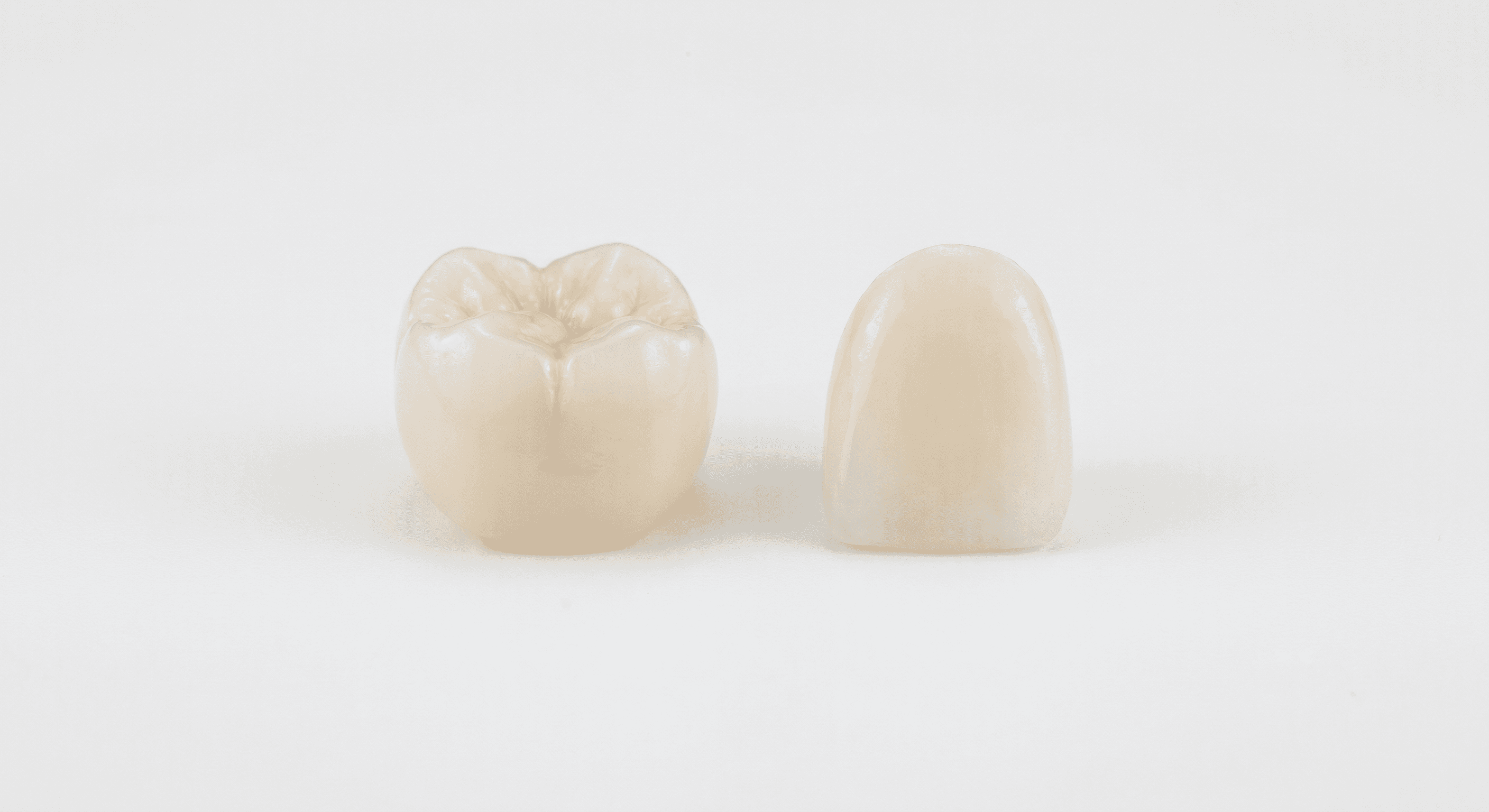
"Should I get a crown or a veneer?" It's a question we hear regularly at Shine Dental. Both can dramatically improve the appearance and function of a damaged tooth — but they serve different purposes and suit different situations. Here's how to understand the difference.
What Is a Dental Crown?
A dental crown is a cap that covers the entire visible portion of a tooth, from the gum line up. It encases the tooth on all sides, providing structural support and restoring shape, size, and appearance.
Crowns are typically recommended when a tooth is:
- Significantly decayed or broken
- Weakened after root canal treatment
- Cracked or fractured
- Heavily filled and at risk of further breakage
- Supporting a dental bridge
Crown Materials - Porcelain/ceramic — excellent aesthetics, suitable for front and back teeth - Porcelain-fused-to-metal — strong with a natural appearance - Zirconia — extremely durable and tooth-coloured - Gold alloy — very durable, sometimes used for back teeth
What Is a Dental Veneer?
A dental veneer is a thin shell — typically porcelain or composite resin — that is bonded to the front surface of a tooth. Unlike a crown, a veneer covers only the visible front face, not the entire tooth.
Veneers are typically recommended for:
- Chipped or worn front teeth
- Discoloured teeth that don't respond to whitening
- Slightly misaligned or uneven teeth
- Gaps between front teeth
- Teeth with an irregular shape
Veneer Materials - Porcelain — highly aesthetic, stain-resistant, durable (10–15 years) - Composite resin — more affordable, can be applied in a single visit, but less durable (5–7 years)
Key Differences at a Glance
| Feature | Crown | Veneer |
|---------|-------|--------|
| Coverage | Entire tooth (360 degrees) | Front surface only |
| Tooth preparation | More tooth structure removed | Minimal preparation (0.3–0.7mm) |
| Strength | High — structural reinforcement | Moderate — cosmetic enhancement |
| Primary purpose | Restore damaged teeth | Improve appearance |
| Typical lifespan | 10–20 years | 10–15 years (porcelain) |
| Cost | Moderate to high | Moderate to high |
| Reversibility | Not reversible | Minimal-prep veneers may be semi-reversible |
When Is a Crown the Better Choice?
Choose a crown when the tooth needs structural repair:
- The tooth has lost a significant amount of structure to decay or fracture
- A root canal has been performed, leaving the tooth brittle
- The tooth needs to anchor a bridge
- You grind or clench your teeth heavily (bruxism) and the tooth needs full protection
When Is a Veneer the Better Choice?
Choose a veneer when the tooth is structurally sound but cosmetically imperfect:
- The tooth is healthy but discoloured, chipped, or slightly misaligned
- You want to close small gaps between front teeth
- You're looking for a smile makeover with minimal tooth alteration
- The tooth doesn't bear heavy biting forces (veneers are mainly for front teeth)
The Preparation Process
Crown Preparation 1. The tooth is reduced on all surfaces (approximately 1.5–2mm) 2. An impression is taken 3. A temporary crown is placed while the permanent crown is fabricated 4. At a second appointment, the permanent crown is cemented
Veneer Preparation 1. A thin layer of enamel is removed from the front surface (approximately 0.3–0.7mm) 2. An impression is taken 3. A temporary veneer may be placed 4. At a second appointment, the veneer is bonded with dental cement
In both cases, digital impressions and shade matching ensure a natural result that blends with your surrounding teeth.
Can You Have Both?
Absolutely. It's common to combine crowns and veneers in a treatment plan. For example, a patient might receive crowns on damaged back teeth and veneers on healthy front teeth to create a uniform, natural-looking smile.
Dr. Cho will assess each tooth individually and recommend the most appropriate restoration. During your consultation, he'll explain why a crown or veneer is recommended for each specific tooth.
Caring for Crowns and Veneers
Both restorations require the same care as natural teeth:
- Brush twice daily with a non-abrasive toothpaste
- Floss daily, including around the margins of the restoration
- Attend regular dental check-ups at Shine Dental
- Avoid using teeth as tools (opening packages, biting nails)
- If you grind your teeth, a night guard can protect both restorations and natural teeth
Frequently Asked Questions
Can veneers fix crooked teeth?
Veneers can create the appearance of straighter teeth for mild misalignment. For moderate to severe crookedness, orthodontic treatment is usually more appropriate and preserves more natural tooth structure.
Do crowns and veneers look natural?
Modern porcelain and ceramic materials are highly aesthetic. When made by a skilled dental technician, crowns and veneers are virtually indistinguishable from natural teeth.
Is the preparation for veneers irreversible?
Traditional veneers require some enamel removal, which is permanent. However, minimal-preparation and no-preparation veneers are available for some cases. Discuss this with Dr. Cho during your consultation.
How long do crowns and veneers last?
With proper care, porcelain crowns can last 10–20 years and porcelain veneers 10–15 years. Regular check-ups help identify any issues early.
Let's Find the Right Solution for Your Smile
Whether you need structural repair or a cosmetic enhancement, Shine Dental can help you understand your options. Book a consultation to discuss crowns and bridges or cosmetic veneers with Dr. Cho.
We serve patients throughout Newington, Wentworth Point, Auburn, Sydney Olympic Park, Silverwater, and Lidcombe.
Call (02) 9748 4822 or book online.
Shine Dental — Unit 5, 8 Avenue of Americas, Newington NSW 2127
Open Mon–Wed & Fri 9am–5pm, Thu 9am–12pm