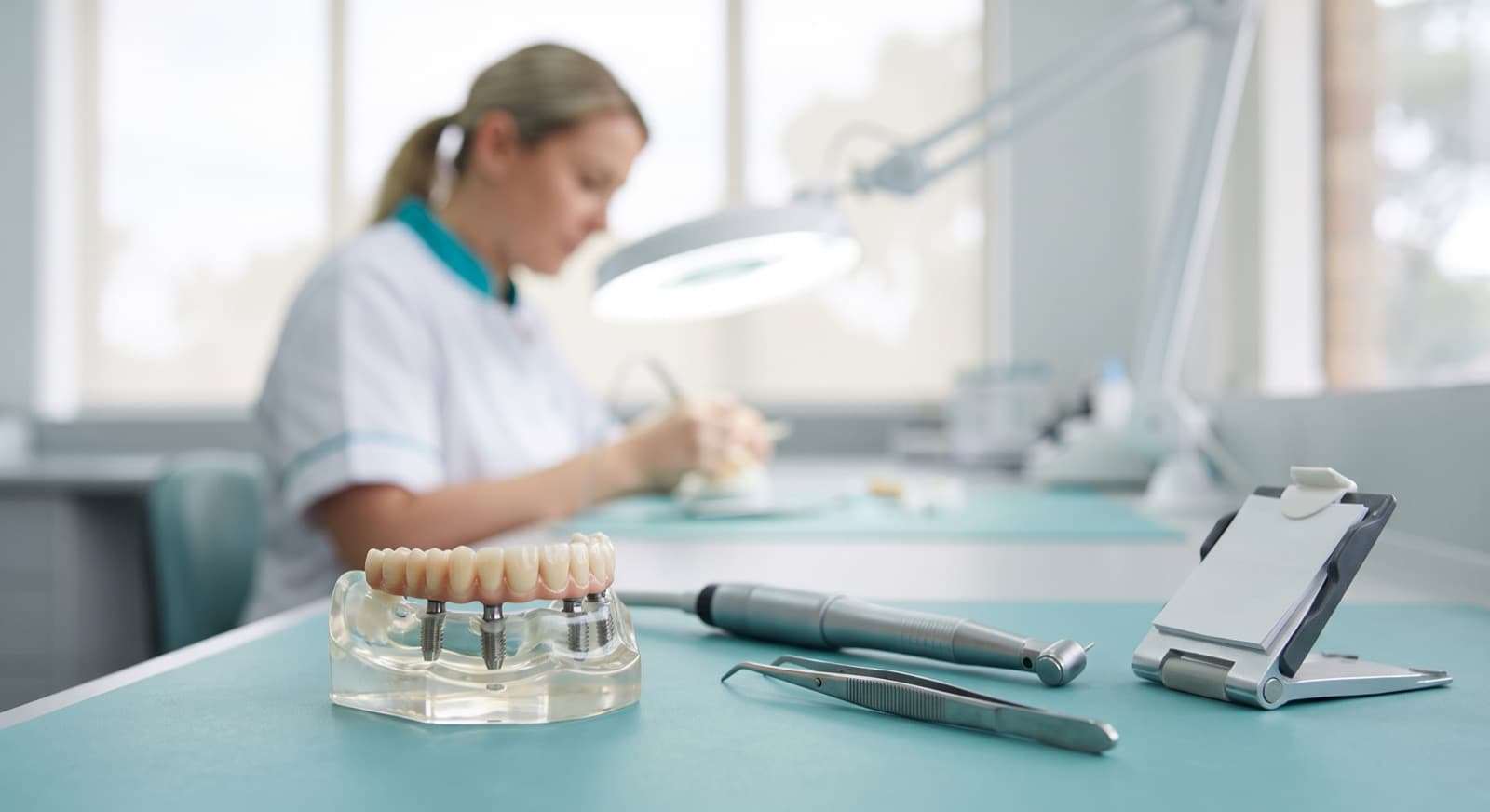
'Teeth in a day' is one of the most appealing promises in modern dentistry — and one of the most misunderstood. The idea that you can walk in with failing teeth and walk out the same day with a fixed set of new ones is genuinely achievable for many All-on-X patients, but the phrase glosses over important details: the same-day teeth are provisional, the approach depends on conditions measured during surgery, and the final teeth come months later. This article explains how immediate provisional teeth actually work, when they are possible, when a staged approach is the wiser path, and what a realistic timeline looks like.
What Does 'Same-Day Teeth' Actually Mean?
In an All-on-X context, 'same-day teeth' refers to fitting a provisional fixed bridge onto your newly placed implants on the day of surgery — a technique clinicians call immediate loading. The provisional is a well-made acrylic bridge, fixed in place and not removable by you, that restores your smile and basic function while the implants integrate with the bone underneath.
What it does not mean is that treatment finishes that day. The provisional is a working prototype: it protects the implants, lets you speak and eat (carefully), and gives you and your dentist a live trial of tooth position, bite, and appearance. The definitive prosthesis — made from stronger materials to a refined design — is constructed later, once healing is complete. Understanding this two-prosthesis structure is also key to understanding what determines All-on-X treatment costs, since both bridges should appear in any itemised quote.
How Can New Teeth Be Fitted on the Day of Surgery?
The short answer is planning plus mechanics. Before surgery, a CBCT scan maps your bone in three dimensions, allowing implant positions to be planned where the bone is densest. During surgery, any failing teeth are removed, the bone is prepared, and typically four to six dental implants are placed per arch — the number is tailored to your anatomy, as we explain in how many implants All-on-X needs.
The critical measurement is primary stability: how firmly each implant is gripped by the bone at the moment of placement, assessed by the resistance recorded as the implant is seated. When the implants collectively achieve sufficient stability, they can be joined together by the provisional bridge. Splinting the implants together through a rigid bridge is itself protective — it distributes forces across all the implants rather than letting any single one be overloaded. That is the engineering that makes same-day teeth possible: not rushing the biology, but stabilising it.
When Is Immediate Loading Possible — and When Is Staging Safer?
Immediate loading is common in All-on-X treatment, but it is a decision confirmed during surgery, not a promise that can responsibly be made beforehand. If the bone is soft, if an implant does not achieve adequate stability, or if extensive grafting was required, loading the implants immediately can jeopardise their integration. In those situations, the careful approach is to stage the treatment: the implants are left to heal undisturbed beneath the gum for a period, while you wear a removable temporary appliance, and the fixed bridge is attached once integration is confirmed.
A staged outcome is not a failure — it is the treatment adapting to your biology. Patients do better when they walk into surgery understanding both possibilities: the surgical plan aims for same-day provisional teeth, and the fallback exists to protect your long-term result. Any practice that guarantees same-day teeth to every patient before examining the bone is promising something no clinician can actually control. Factors like smoking and general health also influence this decision, as covered in who is suitable for All-on-X.
What Is the Timeline From Provisional to Final Teeth?
All-on-X follows a defined sequence: consultation and CBCT scanning, any extractions, implant placement, the provisional prosthesis, and then the definitive prosthesis. When immediate loading goes ahead, the extractions, implant placement, and provisional fitting are usually compressed into the surgical day — which is where the 'same day' lives in the timeline.
What follows is the quiet, important phase: osseointegration, where bone grows onto the implant surfaces. This typically takes some months, during which you attend reviews so healing can be monitored and the provisional adjusted as your gums remodel. Once integration is confirmed, records are taken for the definitive bridge — refining the shape, bite, and shade based on how you have found the provisional — and the final prosthesis is fitted. The provisional phase is not dead time; it is the rehearsal that makes the final teeth right.
What Should You Realistically Expect on the Day and After?
Expect a long surgical appointment, and plan to go home and rest afterwards with someone to accompany you. Expect swelling, some bruising, and manageable discomfort in the first days — normal after extractions and implant placement — and expect to follow a soft-food diet for a period while the implants integrate, since the provisional bridge and the healing bone should not be tested against hard or chewy foods. Expect several review appointments. And expect your speech to take a short time to adapt to the new bridge.
We have written a dedicated guide to recovery after All-on-X covering the day-by-day details. The overall message is positive but honest: most patients are pleasantly surprised by how manageable recovery is, yet the same-day result still needs weeks of sensible care to become a long-term one. Individual healing varies, and no specific outcome can be guaranteed for any surgical procedure — which is exactly why planning, imaging, and experienced judgement matter.
Book an All-on-X Consultation
Whether same-day provisional teeth are realistic for you starts with a CBCT scan and an honest clinical assessment. Dr. Jin-Ho Cho, BDS (University of Sydney, 1987), has 35+ years of clinical experience, has placed 9,000+ implant fixtures, and is a KOL for the DIO Implant System — with a special interest in full arch rehabilitation. Consultations at Shine Dental Newington are available in English and Korean, and every patient receives a written itemised quote with item numbers, with HICAPS on-the-spot claiming and preferred provider arrangements for CBHS and NIB. Call (02) 9748 4822 or book online — Unit 5, 8 Avenue of Americas, Newington NSW 2127.