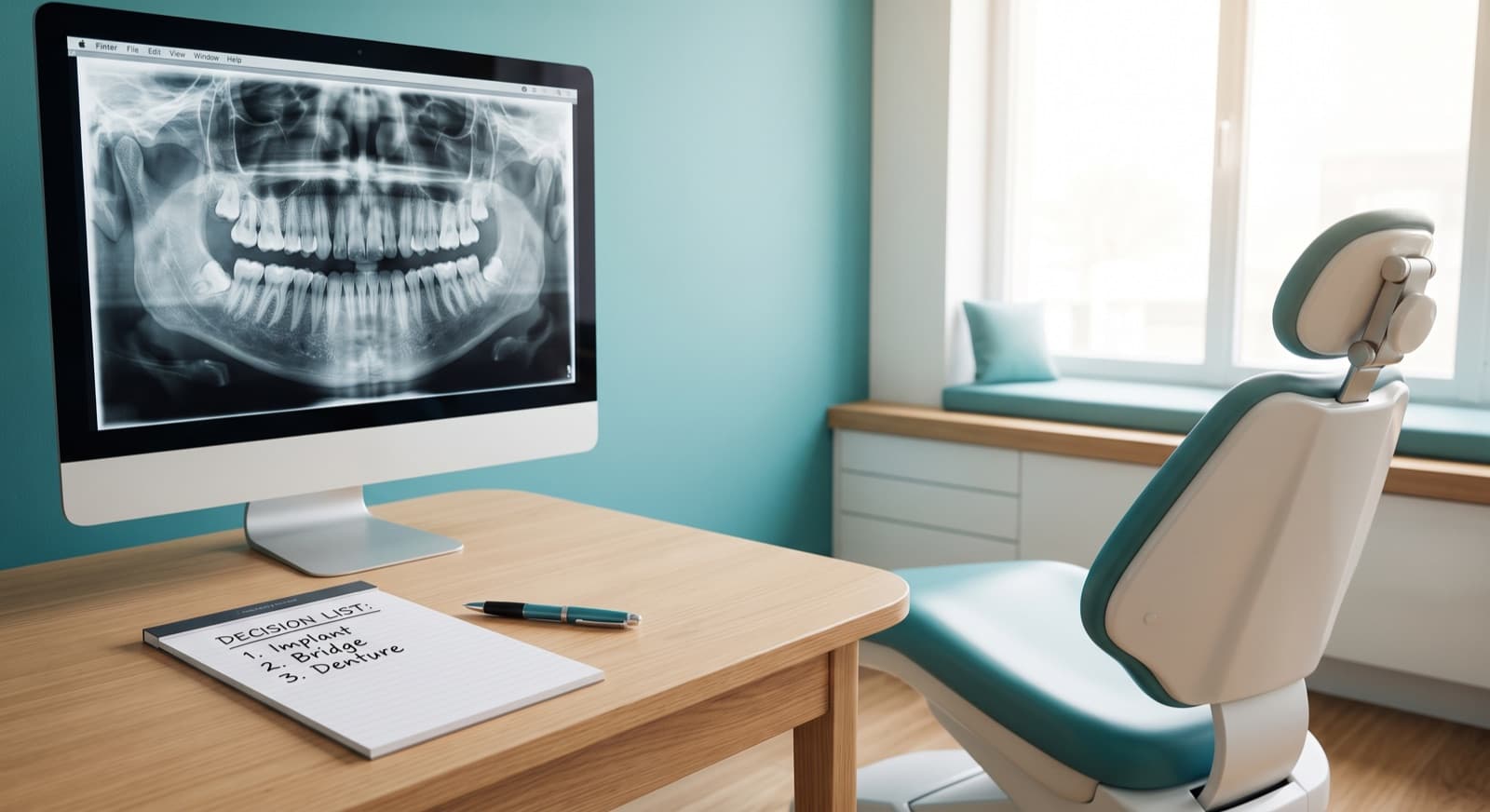
There is a particular stage of dental health that is genuinely hard to navigate: not one problem tooth, but several — teeth that have been filled, crowned, root-treated and re-treated, with gum disease or decay steadily undermining the rest. Patients at this stage often arrive at Shine Dental Newington with the same honest question: do I keep fixing teeth one by one, or is it time for a different plan? There is no universally correct answer, but there is a clear framework for making the decision well. Dr. Jin-Ho Cho (BDS, University of Sydney, 1987) has spent 35+ years in practice and placed 9,000+ dental implant fixtures, and much of that experience is precisely this conversation. Here is how to think it through.
How do I know when saving a tooth no longer makes sense?
Dentistry rightly starts from the position that a natural tooth worth keeping should be kept. The question is what worth keeping means when a tooth is heavily compromised. Some factual markers help. A tooth with little remaining natural structure, supported mostly by filling material and a crown, has less to work with each time it is re-treated. A tooth that has already had root canal treatment and re-treatment, and is failing again, has a narrowing set of remaining options. Teeth loosened by advanced gum disease depend on bone that is no longer there. And there is a cumulative-cost dimension: repeated interventions on a tooth with a doubtful outlook can, over several years, add up to more than replacing it once — without ever delivering stability. The point is not that extraction is inevitable, but that each rescue should be weighed honestly against its likelihood of lasting. When several teeth sit in that doubtful category at once, planning tooth-by-tooth stops being planning at all — and it becomes worth assessing the mouth as a whole.
What are my options when multiple teeth are failing?
The options sit on a spectrum, from most conservative to most comprehensive:
- Selective saving plus staged single implants — keep the genuinely sound teeth, extract the failing ones, and replace them individually with dental implants over time.
- Implant-supported bridges — where several neighbouring teeth are missing, two implants can support a bridge of three or more teeth, replacing a section efficiently.
- All-on-X full-arch treatment — when an entire arch is failing, typically four to six implants support a complete fixed bridge of teeth. Our overview of All-on-X explains the approach in detail.
- Conventional dentures — removable full or partial dentures remain a legitimate option, with their own trade-offs in stability and bone preservation, compared directly in our post on All-on-X versus dentures.
Which pathway fits depends on how many teeth are truly sound, the state of your bone, your health, and your priorities.
How do staged single implants and implant bridges compare with All-on-X?
The honest comparison is about where your arch is heading. If most of your teeth are sound and two or three are failing, staged single implants preserve everything worth preserving — that is their strength. The approach becomes strained when the remaining teeth are themselves doubtful: you can invest in implants around teeth that then fail, forcing repeated rounds of surgery and remade work. Implant bridges occupy the middle ground, rebuilding sections economically in implant numbers. All-on-X is the whole-arch answer: rather than replacing teeth one by one as they fail, it replaces the full arch on typically four to six implants in a single planned sequence, with a provisional bridge fitted the same day as surgery where clinically suitable. Fewer implants than one-per-tooth also means the plan can often work around bone loss rather than being defeated by it — see how many implants All-on-X uses for why.
Where do dentures fit into the picture?
Dentures should not be dismissed. They involve no surgery, are produced relatively quickly, and for some patients — for medical, anatomical or personal reasons — they are the appropriate choice. Their limitations are equally factual: they rest on gums rather than anchoring in bone, so they move under chewing load, and they do not stimulate the jawbone, which continues to resorb beneath them over the years. Many patients use a denture as an interim step while planning implant treatment, and that staged approach is entirely reasonable. What matters is choosing dentures deliberately, with the trade-offs understood, rather than by default.
How does a CBCT consultation map the decision?
Everything above stays theoretical until it is grounded in your actual anatomy. A CBCT scan — a three-dimensional cone-beam image taken on site at Shine Dental Newington — shows what a normal X-ray cannot: bone height, width and density across the whole jaw, the true state of each tooth root, and the anatomical structures that implant planning must respect. From that scan, Dr. Cho can classify each tooth honestly (sound, treatable, or failing), show you exactly why, and map which of the pathways your bone actually supports. Dr. Cho, a KOL for the DIO Implant System, conducts these consultations personally, in English or Korean, and you leave with a plan rather than a sales pitch — including the option of staging treatment over time if that suits your circumstances.
How is the cost structured — and how do I compare my options fairly?
Each pathway has a different cost structure, and comparing them fairly requires itemised detail rather than a single headline number. At Shine Dental Newington every plan comes as a written, itemised quote with individual item numbers, so you can see what each component covers and weigh a staged plan against a full-arch plan on real information. HICAPS is available for on-the-spot health fund claims, and the practice is a preferred provider for CBHS and NIB; Medicare typically does not cover routine adult dental treatment. For how full-arch pricing is built, see our All-on-X cost guide, and for the wider implant pricing landscape, our review of dental implant cost factors in Sydney for 2026.
Ready to map your options properly?
If you are at the decision stage with multiple failing teeth, a CBCT consultation will turn the abstract options into a concrete, personal map. Call Shine Dental Newington on (02) 9748 4822 or book a consultation. Unit 5, 8 Avenue of Americas, Newington NSW 2127 — onsite parking, consultations in English and Korean.