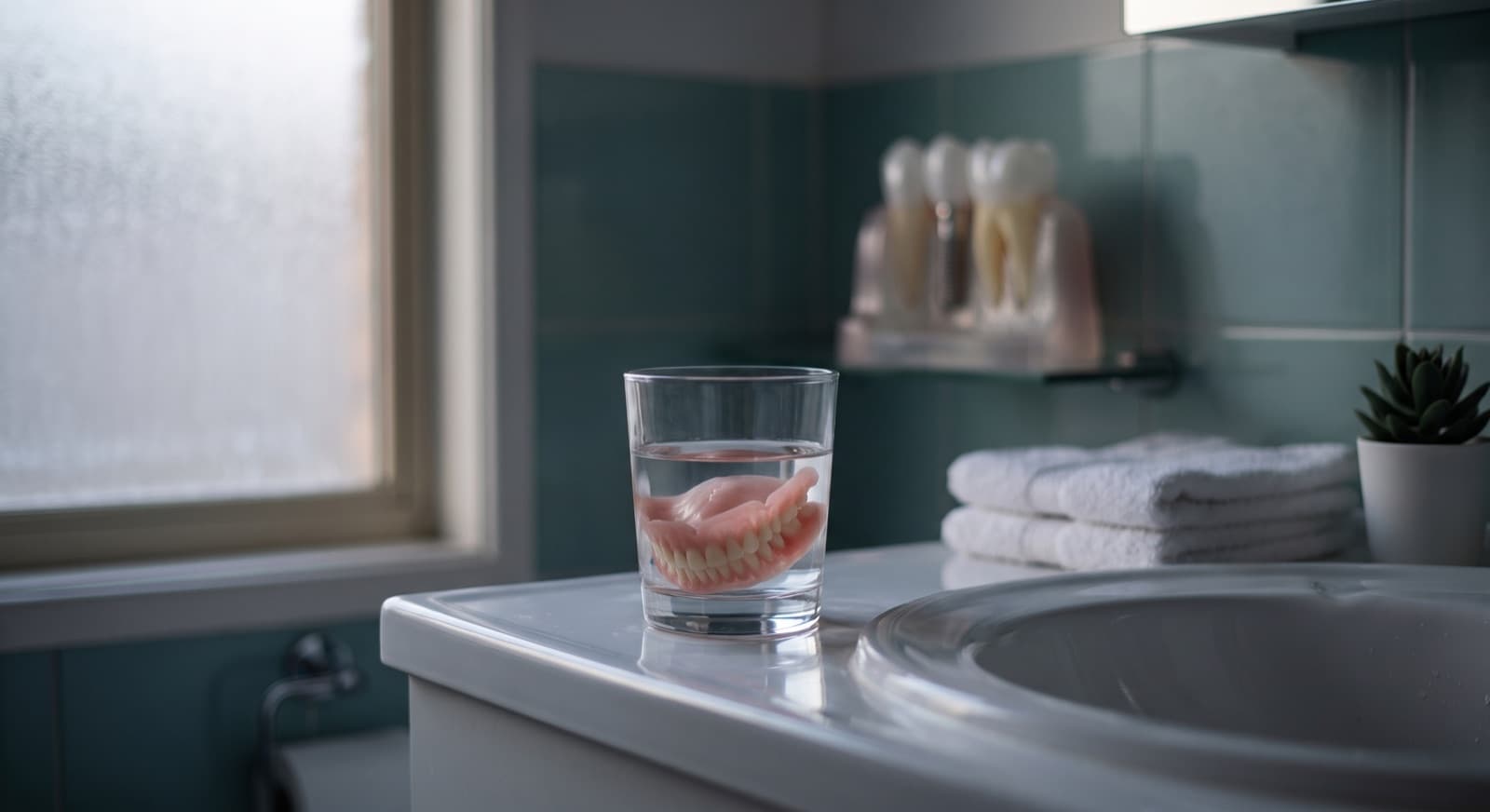
Many of the patients who ask about All-on-X at Shine Dental Newington are not new to tooth loss at all — they have worn full or partial dentures for years, sometimes decades. They know the routines: the adhesive, the soaking, the foods quietly avoided, the awareness of a plate that moves when it should not. For these patients, the question is not whether dentures work, but whether fixed teeth on implants would work better for them — and what the switch actually involves. Dr. Jin-Ho Cho (BDS, University of Sydney, 1987) has placed 9,000+ dental implant fixtures over 35+ years of practice, and a significant part of that work has been transitioning long-term denture wearers to fixed full-arch teeth. Here is what the change really looks like.
What actually changes day to day when you move from dentures to All-on-X?
The defining difference is that an All-on-X bridge is fixed to implants — typically four to six per arch — and only a dentist removes it. That single fact changes a surprising number of daily habits. There is nothing to take out at night, no adhesive, no soaking container by the sink. The upper bridge has no palate plate, so the roof of the mouth is uncovered — many long-term upper denture wearers notice food temperature and taste more fully again. Because the bridge does not rest on the gums, the pressure points and sore spots that come with a moving denture are not part of the picture, and biting force transfers through the implants into the bone rather than through soft tissue.
For a fuller side-by-side comparison of the two approaches, see our guide to All-on-X versus dentures for full-arch replacement.
How does years of denture wear affect my jawbone — and my treatment plan?
This is the most important clinical reality for long-term denture wearers to understand. When teeth are lost, the jawbone that held them no longer receives chewing stimulation through tooth roots, and it gradually resorbs — shrinks in height and width. Dentures rest on top of the gum and do not stop this process; in fact, years of denture pressure are often accompanied by significant resorption. This is why dentures that fitted well initially become loose over time.
For All-on-X planning, the amount and location of remaining bone shapes almost everything: where implants can be placed, at what angles, whether four or six implants are appropriate for your arch, and how the bridge is designed to replace not just teeth but lost gum and bone volume. This is planned precisely from a CBCT scan, not guesswork. Our post on how many implants All-on-X uses explains how anatomy drives that number.
What does the transition process look like?
The pathway follows the standard All-on-X stages, with some considerations specific to denture wearers. It begins with a consultation and CBCT scan at Shine Dental Newington, where Dr. Cho assesses your bone volume in three dimensions, examines your existing dentures and discusses your goals. If any remaining teeth need removal, extractions are planned into the sequence. Implants are then placed — and where clinically suitable, a fixed provisional bridge is attached on the same day, meaning some patients arrive with a denture and leave with fixed provisional teeth. After a healing period of months, during which the implants integrate with the bone, the final prosthesis is made and fitted. What happens between surgery and final teeth is covered in detail in our guide to recovery after All-on-X.
Can my current dentures help design my new teeth?
Often, yes — and this is a genuinely useful part of the assessment. Your existing dentures carry years of information: the tooth size and shade you are used to, where your bite currently sits, how much lip support the denture provides, and equally, everything you dislike about them. If your dentures look right and feel close to right, they can inform the shape and position of the new fixed teeth. If they have never felt right, that becomes a clear design brief for what should change. Dr. Cho reviews your dentures at the consultation for exactly this reason, and the discussion happens in English or Korean, whichever you prefer.
How long does it take to adapt to fixed teeth?
Be realistic here: fixed teeth feel different, and different takes time — even when the difference is positive. In the early weeks, many former denture wearers notice how solid the bridge feels, and some are initially conscious of speech as the tongue adjusts to a palate-free upper bridge after years of a plate. Chewing confidence tends to build progressively as you rediscover foods that were off the menu. Most adaptation is measured in weeks rather than months, and it runs alongside the normal healing timeline. There is also a learning curve for cleaning, since a fixed bridge is cleaned in place rather than at the sink — a small routine change that quickly becomes habit.
Is All-on-X suitable for every long-term denture wearer?
Not automatically — suitability is a clinical question, and severe bone resorption, certain medical conditions and other factors all enter the assessment. The encouraging news is that modern planning techniques, including angled implant placement, mean that many patients with significant bone loss remain candidates without additional grafting, though this can only be confirmed from a CBCT scan. Our post on who is suitable for All-on-X covers the assessment in depth. On the financial side, you receive a written itemised quote with item numbers before anything begins, HICAPS is available on the spot, and the practice is a CBHS and NIB preferred provider — our All-on-X cost guide explains how quotes are structured. Medicare typically does not cover routine adult dental treatment.
Ready to find out whether you can retire your dentures?
A consultation with a CBCT scan will tell you, specifically for your jaw, what the switch from dentures to All-on-X would involve. Call Shine Dental Newington on (02) 9748 4822 or book a consultation online. We are at Unit 5, 8 Avenue of Americas, Newington NSW 2127, with onsite parking, and we consult in English and Korean.