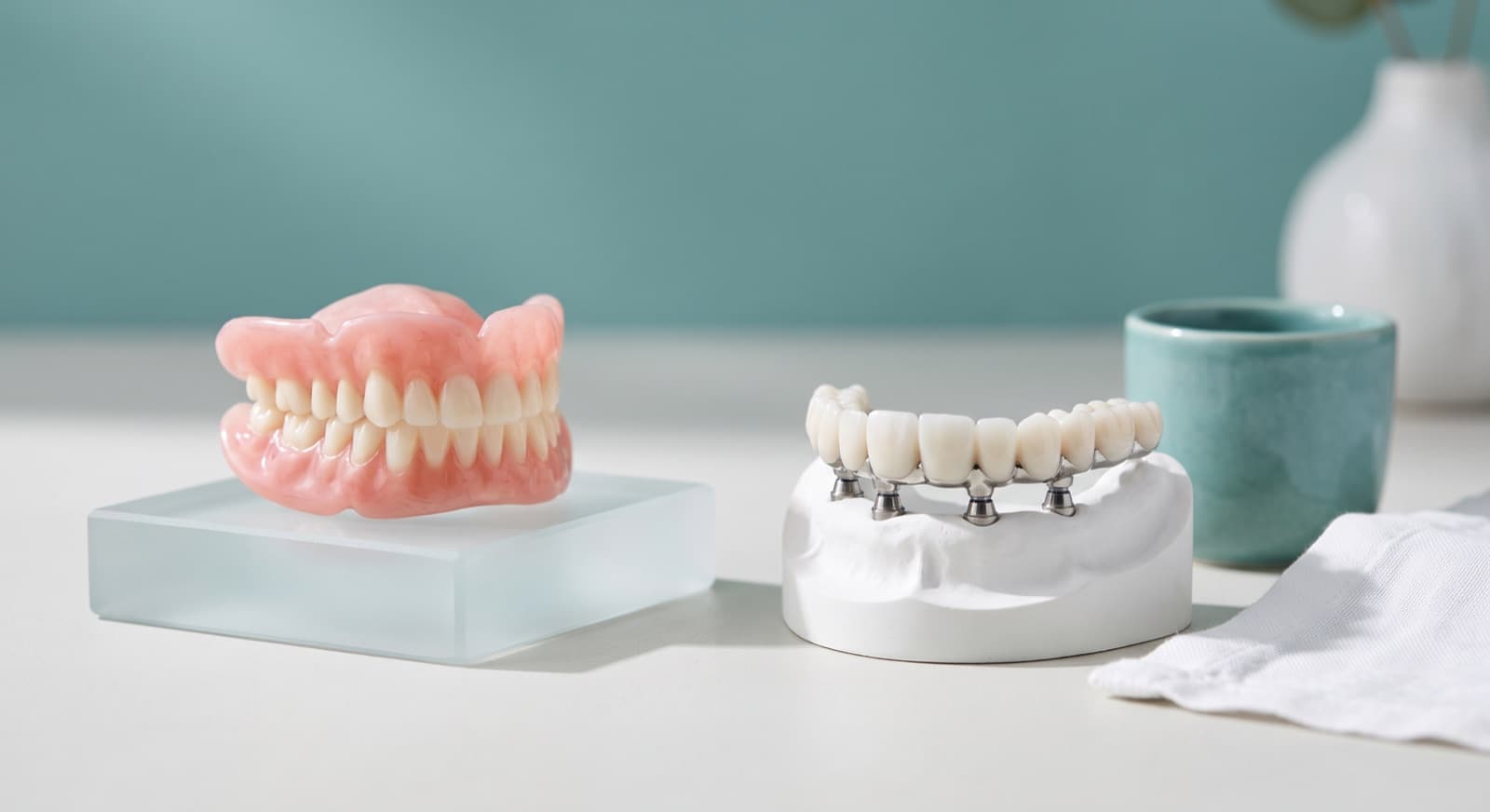
Discussions about replacing a full arch of teeth often present two options: a conventional denture, or a fixed full-arch bridge on implants. There is a third arrangement that sits between them, and for some patients it is the better fit. An implant-retained denture — sometimes called an overdenture — is a removable denture that clips onto implants rather than resting on the gums alone.
Dr. Jin-Ho Cho at Shine Dental Newington — BDS (University of Sydney, 1987), more than 35 years in practice, over 9,000 implant fixtures placed — discusses the full range of options at consultation, because the right answer depends on the individual rather than on the technique.
How does an implant-retained denture work?
Two to four implants are placed in the jaw. Attachments are fitted to them, and matching housings sit inside the denture. The denture clips into place and is held there, but you remove it for cleaning and overnight.
The difference from a conventional denture is stability. A standard lower denture rests on a ridge of gum that offers little to grip, which is why lower plates are notoriously prone to lifting. Clipping the denture onto implants changes that mechanically.
The difference from All-on-X is that an All-on-X bridge is fixed. It is attached to the implants and only your dentist removes it. An overdenture stays removable.
Who might this option suit?
It tends to suit people in a few situations.
Those whose main complaint is a loose lower denture often find this addresses the specific problem without the scope of full-arch fixed treatment. The lower jaw is where conventional dentures struggle most and where added retention makes the biggest practical difference.
Those for whom bone volume or medical factors make a fixed bridge less straightforward may find that fewer implants are workable where more are not.
Cost is a genuine consideration too. Fewer implants and a simpler prosthesis generally mean a lower total than fixed full-arch treatment. That said, the figures vary with the case, and comparing them properly requires an itemised quote for each option rather than a general rule.
What are the trade-offs?
Being honest about the limits matters more than listing the benefits.
It still covers the palate in most upper cases. Many patients dislike an upper plate because it covers the roof of the mouth and dulls taste and temperature. Some overdenture designs reduce that coverage; others do not. A fixed bridge avoids it.
It still moves, just far less. Clipping onto implants greatly improves retention, but the denture is not rigidly fixed and some movement remains, particularly with only two implants.
Chewing capacity sits between the two options. It is a clear improvement over a conventional denture and generally less than a fixed bridge.
The attachments wear. The clips or housings are consumable parts and need replacing periodically — commonly every year or two, depending on use. This is normal maintenance rather than a fault, but it is an ongoing cost and appointment to plan for.
You still take it out. For some people that is welcome, because cleaning is straightforward. For others, removing teeth at night is exactly what they wanted to leave behind. This is a preference worth being clear about with yourself before deciding.
How does the treatment sequence run?
Planning begins with a CBCT scan taken on site, which shows bone height, width and the position of nerves and sinuses. From that, the number and position of implants is planned.
The implants are placed surgically. A healing period follows while they integrate with bone. In some cases an existing denture can be adjusted and worn during healing; in others a new interim denture is made. Once integration is confirmed, the attachments are fitted and the denture is either converted or newly made to house them.
The overall span is measured in months rather than weeks, most of it healing time.
How does it compare with what I have now?
If you currently wear a conventional full denture, the most noticeable change is usually confidence when eating and speaking — not having to think about whether the lower plate will shift. If you are facing the loss of your remaining lower teeth and weighing what comes next, this option is worth putting on the table alongside All-on-X and conventional dentures rather than choosing between two extremes.
Our article on switching from dentures to All-on-X covers the fixed route in detail, and All-on-X versus full dentures compares the ends of the spectrum.
Risks and individual variation
This is implant surgery and carries the considerations that come with it: swelling and discomfort during healing, a risk of infection, and the possibility that an implant does not integrate as expected. Smoking and poorly controlled diabetes reduce predictability. Gum health around the implants needs ongoing attention, as discussed in our article on caring for implants.
Results differ between individuals. How well any of these options works for you depends on your jaw, your health and your expectations, which is why an assessment comes before a recommendation.
Arranging an assessment
At Shine Dental Newington you receive a written, itemised quote with item numbers before anything is booked, so you can compare options and check them against your cover. HICAPS on-the-spot claiming is available, and the practice is a CBHS and NIB preferred provider. Consultations run in English or Korean.
Call (02) 9748 4822, mobile 0430 442 018, or send an enquiry.